AI-assistant for Searching Case Law Precedents
Paste a case. Get results, summarised with sources, in under a minute.
4 min readChallenge
Legal professionals spend hours searching Rechtspraak.nl for precedents. The public portal offers basic search and filters, but with over half a million records this can be a slow process. The goal was build an AI-assistant that could read a case, understand the key points, and search for matching precedents.
Goal
Turn manual case law research into a process that takes seconds by automating the search for relevant precedents.
Proposed Solution
A legal professional pastes case text into a simple interface. The system pulls out key legal concepts and uses them to search Rechtspraak.nl. Results return as short summaries with direct links to the original rulings.
Real-world relevance
Concept validation
Shows that AI can decrease legal research time without removing the professional from the process.
Applicable to
Organizations
Departments
Roles
Skill transfer
Works for any large document set that is slow to search like court rulings, compliance records, medical literature, internal archives.
Industry pattern
Any profession that spends time reading documents to find the right ones can use this pattern. The system assists and the expert makes the call.
Plan
- 1Read the pasted case and extract the legal concepts and statute references that matter. This ensures searches match the real issue.
- 2Use the extracted terms to search Rechtspraak.nl and normalise the responses. Clean data keeps results consistent.
- 3Show each matching case as a clear summary with a direct link to the original ruling. This saves time and maintains trust.
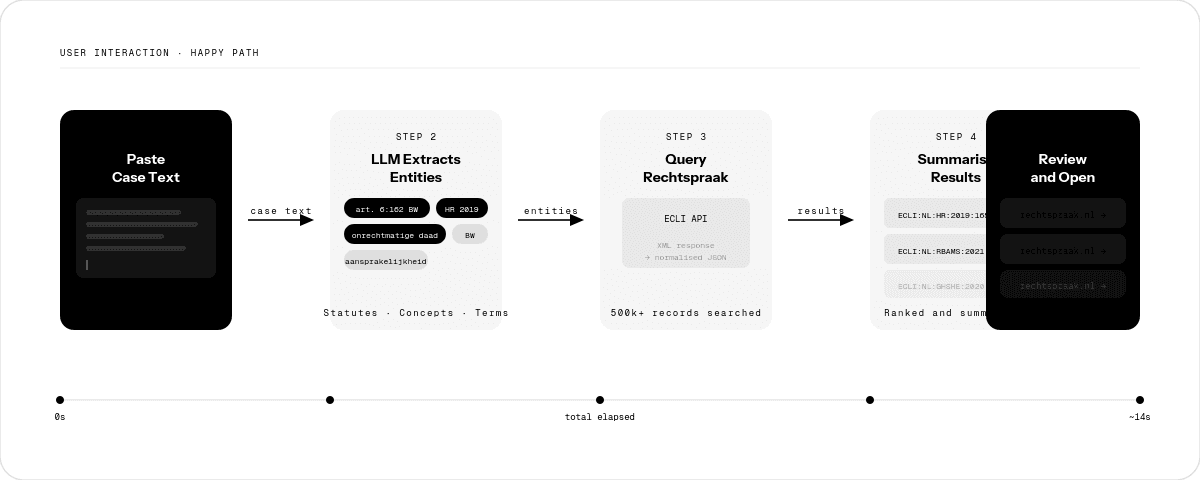
User flow: a legal professional pastes their case text, the system extracts the key legal concepts, searches Rechtspraak.nl, and surfaces readable summaries with source links in seconds.
Impact
Research time per case
<1 minute
compared to what could take hours of manual searching and reading.
What I Learned
- –In high-stakes domains, AI should support decisions, not replace them. The human should be the judge and stay in control.
- –Showing which legal concepts were extracted from the pasted case explains why results appear and builds trust.
- –Sometimes no precedent fits. Fast and clear feedback of that nothing relevant exists still saves time.
Understand the data before building around it
Mapping and normalising the data early made later schema changes easier and kept testing consistent.
Challenges & Solutions
Searching a public government API many times
The Rechtspraak API times out if search too often.
How I tackled it
A backoff strategy added short pauses between requests to prevent timeouts.
Summarising rulings without losing meaning
Court rulings are long and formal. Summaries must stay accurate while being quick to read.
How I tackled it
Summaries kept key facts, reasoning, and outcome in plain language, always linking to the source ruling.
Reflections
Data structure is an important decision
What I thought
The assumption was that the shape of the data can be cleaned up later once things are better understood.
What I learned
Time spent understanding the data before writing anything is very important. How results are structured affects what can be shown.
Required resources
Data
Infrastructure
Expertise
Technical Approach
Programming Languages
Frameworks & Libraries
Infrastructure & Hosting
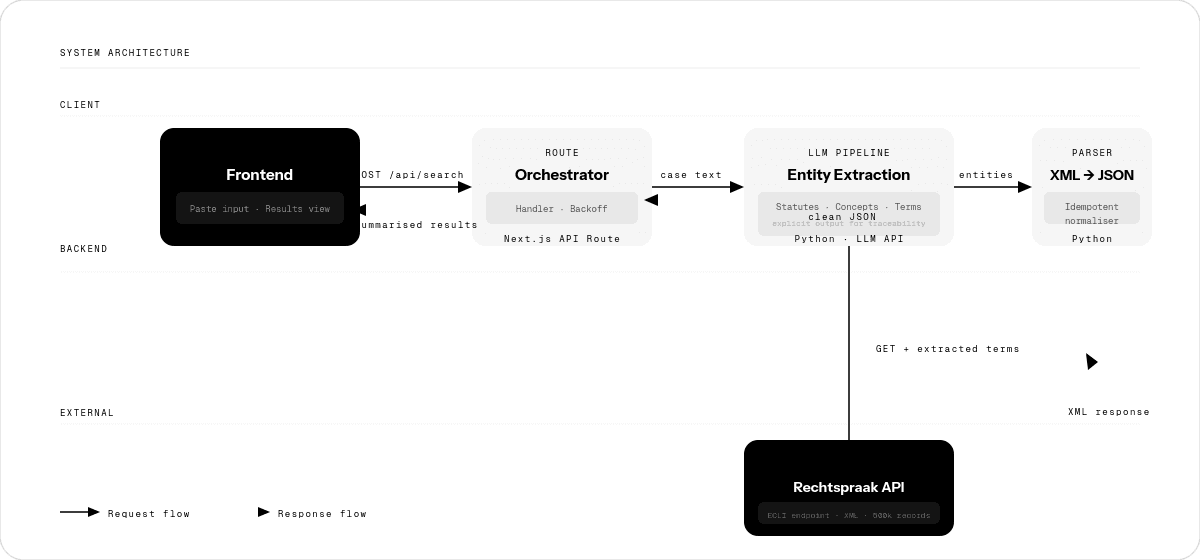
System architecture: pasted case text is sent to an API route where an AI model performs concept extraction, the extracted terms drive queries to the Rechtspraak ECLI API, and the responses are normalised and returned to the interface as readable summaries.
Want to get in touch?
If this project is relevant to something you’re building, you have any quesions, feedback or interested in having a chat, feel free to reach out.